Good Yom Tov.
I’ll be honest—I didn’t have a drasha until yesterday. Thank God for ChatGPT. Just kidding!
Every Disney movie has a moment where they try to make you cry. Who could forget Bambi’s mother getting shot. Or Dumbo’s mom getting locked up. Let’s play with these kids deepest fears right?
Well, one that was on the outside less horrible, but no less of a tear jerker was the moment that Tinkerbell almost dies in Peter Pan. She had drunk some poison to save Peter from drinking it and she is dying. But before she does, Peter realizes we can save her life if we all say, “I believe in fairies”. So all the children shout, “I believe in fairies!!” and slowly but surely, little Tinkerbell comes back to life! Beautiful, but it makes no sense.
What do you mean, I believe in fairies? She’s right there dying… What are you even talking about.
The answer to this question is the secret of Peter Pan and the reason why it’s my favorite Disney movie. Peter Pan is not really about Peter Pan! It’s about Tinkerbell and fairies! He’s just a kid who’s decided not to grow up. But wait, you tell me, He can fly!! No. He can’t fly. Unless he sprinkles fairy dust and Tinkerbell juice on himself. That’s the secret. Tinkerbell-He’s nothing without her.
The theme of the movie then is to never lose your belief in the wonder, the magic, and the mystery of life. It is represented by Tinkerbell and fairies. As long as we believe, the magic and wonder in our lives will stay vital and we will never lose our youthful joy and optimism. Now that’s a great Disney lesson!!!
Here we are. Rosh Hashanah. The beginning of the year. Or as our tradition so beautifully calls it—“Hayom Haras HaOlam”— literally: the day the world was conceived. A new beginning. A reset. If you think about it, there are no happier occasions than a healthy birth or a wedding. They both mark something completely new. A new life and a new family. That which is new is the cause for incredible joy. Why is this? Why would I argue that as the birth of the world, today should be a day of incredible joy?
Part 1: Rosh Hashanah as Resensitization
The older we get, the less we’re surprised.
You remember the first time you saw something shocking on the news? You couldn’t believe it.
But now? Another tragedy, another scandal—we scroll past it.
It’s not that we stop caring. It’s that we’ve become desensitized.
And it used to be that the adults saw more than the kids, but today with their social media, unfortunately, the kids see the horrific videos that accompany to news we hear. Videos that the regular news stations would never show. Can you imagine what this does to the minds of our children?
The Gemara teaches that when we do or see something wrong often enough, we give ourselves a heter (an allowance)—we rationalize and now the behavior feels ok. We stop noticing. We begin to think that bad is normal, or even acceptable.
It’s not even just the bad things that we become desensitized to.
Life is general is very repetitious. So many of us typically follow a routine, as we should, because routine helps us live a structured, productive, and meaningful life. But sometimes, the routine can also make life feel meaningless. Just a repetition of the same thing day after day. For some reason, I feel it when I take my pills each day. Day after day, taking the pills, reloading the holder once a week, on and on forever.
Repetition, as helpful as it is, can diminish our viewing of the world as beautiful, mysterious, and new. It’s life on auto-pilot, almost as if we have fallen asleep.
Rosh Hashanah comes once a year and says: Wake up!
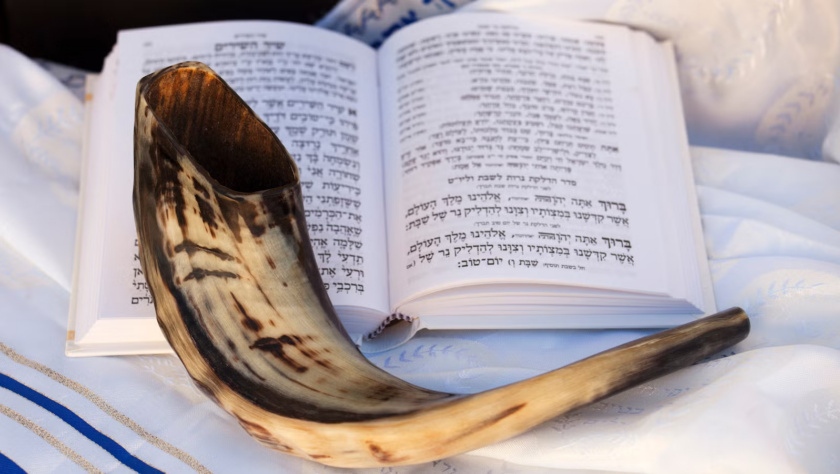
That’s Maimonides understanding of the shofar – Wake up!!
It’s a divine reset button for our hearts.
It demands that we re-learn to be surprised—by beauty, by goodness, and yes, by evil too.
Because if we stop expecting good, then there’s no bottom to how far things can fall.
That’s how the Evil German — yimach shmo — did it. One step at a time. Desensitizing, numbing, normalizing, until the unthinkable became routine.
Part 2: Expecting Goodness Again
And this desensitization—it doesn’t just happen in the world. It happens in our relationships.
Rosh Hashanah calls us to resensitize ourselves to each other.
We say “I’m sorry” not just because we messed up, but because we want to feel responsible again—for our spouses, our friends, our parents, our children.
And in the process, we begin to reset our expectations of the world and the people around us.
What kind of world should we expect? How should we view the people we see.
Judaism asks us to believe in a world that is beautiful, joyous, and good, and to love everyone you see just as you love yourself.
Part 3: But the World Feels Broken…
Just a week or two ago, my daughter Lila said something to me that broke my heart.
She said, “Abba, I just feel like the world is so bad.”
And I told her this:
If the world was truly bad, we wouldn’t be surprised when something bad happened.
It wouldn’t even make the news.
The reason bad events are newsworthy is because they break our expectation of goodness.
If evil becomes expected—then we’ve lost something essential.
“Lila,” I said, “You have so many incredible things to look forward to. This world is filled with incredible beauty for you to discover.”
But it’s not easy….
Part 4: But We Still Believe
Think about the hostages. Two years of praying for them. Week after week, saying their names.
It would be so easy to give up hope. I’ve heard people say, “Uch, they’re never getting out.”
But we say the opposite.
We still believe. We still hope. We expect miracles, because we believe in a miraculous world.
Even Israelis themselves — war-weary, a society burdened by PTSD — ask, “Will this ever end? Can life go back to normal?”
And Rosh Hashanah answers: L’Shana Haba B’Yerushalayim. We don’t accept defeat.
Good will triumph!!
We dream of a new year, a better year.
This is not to say that we don’t take action to fix the world. We’re not trying to convince ourselves that everything is perfect. But if we don’t believe in the potential for change, why would be even try. Not fake optimism, but rather hope and vision.
Part 5: There’s More Good Than Bad
I want to tell you a story.
Recently, I met two paramedics who worked for Magen David Adom, Ofir and Achmed. A Jew and an Arab, who are like brothers in their long partnership in saving lives in Israel. In the recent attack by Iran, Ahmed’s apartment building in Haifa was hit by an Iranian missile. It was badly damaged but not destroyed. But the building next door was totally destroyed
I don’t know if we appreciate how destructive these missiles are. The fact that only 28 people were killed by them is miraculous. 28 is a lot, 27 of them were civilians, but it could have been hundreds or thousands if not for the missile sheild and bomb shelters, and Hashem’s kindness.
But as soon as Ahmed got his family to safety, he jumped into his ambulance…
…and rushed off to treat Jewish Israelis wounded just a few blocks away.
That’s the real Israel. That’s the real world.
It’s not always simple. It’s complicated. It’s messy. But it is so, so good.
The media deals in absolutes. Black and white. Evil or righteous.
But real life? Real life is filled with people like Ahmed.
For every evil act we hear about, there are a thousand acts of love, decency, kindness, and bravery.
Part 6: Don’t Be Defined By One Mistake
And the same is true for ourselves.
Sometimes we mess up.
We do something wrong. And instead of focusing on the hundreds of things we do right, we get carry the thing we did like a burden on our heart.
And we start to believe, “Maybe I’m a bad person.”
But you’re not!
you’re a good person who did a bad thing. And you can fix it.
When I interned at Rikers Island, Rabbi Sachs—who had been the chaplain for decades—said to me,
“This place is full of good people who did very bad things.”
And it was true. They weren’t monsters. They were people. Struggling. Searching. Learning. They had to pay for their sins with time. We are more fortunate. We just have to suffer through Rosh Hashana and Yom Kippur!!!
Rosh Hashanah gives us a chance to let go of that weight, so we can begin again. We remember our shortcomings in order to let them go and once again focus our attention on being the best people we can be.
The Torah and Observance as new and fresh
In last weeks Parsha, Moses tells the people, “This day Hashem your God has commanded you to observe these laws and rules faithfully with all your heart and soul (Deut 26:16)”
The medrash quoted by Rashi quips, “When Moses says ‘This Day’, he really means ‘Every day’. Every day they should feel new and fresh in your eyes.”
Don’t get desensitized to mitzvos or Jewish practice.
Part 7: The Shofar Wakes Us Up
Desensitization shows up in two forms:
- Complacency – tuning out, zoning out.
- Negativity – pessimism, defeatism, cynicism.
The shofar comes to say: “Wake up, you sleepers!”
The apple in honey says: “There’s still sweetness in the world.”
The Book of Life reminds us: “Your story is still being written.” It’s never too late. Though as a wise rabbi once said, “it’s later than you think.”
Part 8: Judaism Is a Religion of Change
“Rosh Hashanah” doesn’t just mean the head of the year.
“Shanah” also means change.
Rosh Hashanah can mean, the beginning of change
Judaism is a system for change and growth
Its a view of life that the meaning of life is to grow as a human being
In our consciousness, our morality, physically, spiritually, skills, knowledge, finding truth
Judaism is a system for transformation. For growth. For moral courage.
We’re not just here to stay alive, to avoid pain, to seek comfort.
Someone once told me after retiring, “I’m just wasting time waiting to die.”
I hope they were joking.
Because Rosh Hashanah tells us—life is more than that. and if you’re here for High Holidays, I think you believe that too.
When we say the word Teshuva. That’s what we mean. Not guilt and sin and punishment, but rather renewing our belief that the meaning of life is a persistence movement towards good. Towards better. Towards our true best version or ourselves which we never give up hope of reaching. And we will never reach that place but in setting it as a goal, our lives will be lived in the process of striving. None of this can happen if you’ve lost hope in yourself, so Rosh Hashana tells us to start again.
Part 9: The World is New, Right Now
Every morning in our siddur, we say:
“Hamechadesh b’tuvo b’chol yom tamid maaseh bereishit.”
God doesn’t just sustain the world every day.
God recreates the world every moment.
Right now… and now… and now… the world is being born again.
And if the world is being renewed, we can be renewed too.
That’s what we mean when we say: Or Chadash—“a new light.”
Is it a new moon? A new sun?
If not what are we talking about?
An enlightened view if you will
We bless God who creates a new light…not outside of us, but inside of us.
We need new light!!!!
Not outside of us, but within us.
We need that light.
Part 10: Reset to Joy
Joy is not a luxury in Judaism.
It’s an obligation.
Rav Sacks once taught that the great sin of the Tochecha wasn’t idolatry or theft or murder.
It was this: “Because you didn’t serve Hashem with joy.”
It’s not enough just to not do bad things.
Rosh Hashanah is about renewing our joy, our excitement, our positive attitude, our faith in life.
Depression comes when we feel like there is nothing new to live for.
There is sooooo much to live for
Every day is something new to live for.
We have to get that in perspective and hold onto it.
Sin keeps you from being new.
It holds you in the past
You are carrying the past with you
We come here today to let it go
With forgiveness from sin you have the freedom to grow forward towards that new person you dream of becoming.
Conclusion: A New Year, A New Light
I turned 44 this year but I want to see the world like a child my whole life.
There is so much in the world to love.
So much to look forward to.
So much to be surprised by.
Don’t let the fear win.
Don’t let the cynicism numb you.
Don’t let your mistakes define you.
Let this Rosh Hashanah be a reset.
Let it be a return to hope,
a renewal of the heart,
and a reminder that life is spectacular, every day, every moment.
I know this is a little corny but humor me. Say with me:
Life is more than politics
Life is more than what we hear about in the news
The world is beautiful
Life is worthwhile
The future can be bright
I’m not bad
I have so much potential
Israel will find peace
We are so blessed
Every moment is an incredible gift.
And…I believe in fairies!!
Shanah Tovah U’Metukah.
May you have a sweet, surprising, joyous new year.
So happy birthday world!