Stop Striving and Start Thriving (Or How I Learned to Stop Worrying and Trust Hashem)
About a month ago, I got a note on my desk from someone who to their credit or perhaps as a credit to their chutzpah, did not remain anonymous:
I quote: “Rabbi…You should shorten your sermons. They are too long. You are in love with your own voice. Try making your point in 15 minutes.”
All I can say is, “Bertha, point taken”!
1. After I graduated High School in Chicago from Skokie Yeshiva, I studied for 2 years at Yeshivat Hakotel in the Old City of Jerusalem. The head of the yeshiva was a rabbi who was quite a character named Rav Aharon Bina. You could write a book with the funny and pithy things he has said over the years but one of his musings sticks out in my mind. He once said, “None of you believe in God… How could you? You are 18 years old and you think you are going to live forever. That means you think you are God. But just wait…one day, you will realize you have reached the top of the mountain and start you’ll begin your descent down the other side, and then when you realize where you are headed, you’ll need God, and then you will believe in God….but you’re young and happy. Don’t think about such things.”
Up until that point, whenever I had thought about life as a mountain, the metaphor was a lifelong accent to the top. There was no going down. Only a tough accent with moments of downhill but generally a continuous upward march. Now I realize this is only true when applied to the intellectual and spiritual journeys of life. Rav Bina’s mountain image, the getting to the top and coming down the other side is a much more banal and physicality-based metaphor… and yet, when we struggle with health, nothing feels more deep and real. And he is right; we should embrace the fact that eventually we must make our way back down the mountain as gracefully and peacefully as we can.
So God comes into our lives out of necessity on the second part of our life’s journey and either we turn to God out of fear, or we turn to God in faith and in trust- “For I know you are with me, your rod and staff they comfort me”.
I remember saying this to Hashem 6 years ago when I was at University of MD hospital facing an unknown cancer diagnosis. I said, “Hashem, I trust you. I know I’m in your hands and I’m not afraid. Whatever you do, I accept…but I ask you to give me more time. I have children to raise and a wife to love. I have a congregation to take care of and guide. Please, save me.”
My last treatment of Cladribine and Rituximab was the day before Rosh Hashana 2020, and on this 6th anniversary, I feel so deeply grateful to God for giving me another year of life.
2. But this year was interesting. This year was different. This was the year I got to the top of my mountain. I’m not sure what did it, but I’m sure I’m no longer a kid. Last year, I still thought I was a kid. I know it’s embarrassing…for you guys to have a child as your rabbi… Well don’t worry, I’m finally a man… where’s my fountain pen??
I knew I had changed but I couldn’t figure out what it meant so I started asking some of my close friends. “Brad. What do you think this stage of life is about?”
He said, “I’m very happy. This is a great stage of life. It’s about maintaining. I have everything I want. Now I just have to keep doing what I’m doing.”
I didn’t like hearing that at first. It sounded as if he were giving up on growth and great goals, and resigning himself to a simple but stagnant existence. When I discussed Brad’s answer with Helene that evening, she helped me realize that sometimes the focus on growth and big goals holds you back from being satisfied and enjoying what already is. Life without striving is indeed stagnant, but a live of only striving knows no reflection, no gratitude, and no true gratification. For the six days of work, we all need a Shabbos.
I asked my friend Jon the same question: What do you think this stage of life is about?”
He said, “For me, it’s all about gratitude. Looking around and realizing how blessed I am.”
These two very wise observations made a huge impact on my thinking throughout the year. It became a year of gratitude and a year of self-acceptance. A year not to envision more Quixotic goals, not to be lost in the pursuit of an image of what I could be or what I ought to be, and what things around me I could change, but rather, this was my year to finally take a moment to appreciate who I am and where I am without having to keep on moving and striving for once.
It was my year to Stop Striving and Start Thriving…
3. Most years I preach to you about Renewal and Growth.
This year, I preach to you about Brad and Jon. Today, I’ll focus on Brad’s insight, on Yom Kippur, I’ll speak about Jon’s.
As Brad said, “it’s about maintaining. I have everything I want. Now I just have to keep doing what I’m doing.”
This year, I want you to appreciate that Rosh Hashana is not just about goals or changes, but rather accepting your life as is and realizing that all along you’ve been growing naturally, beautifully, like a tree. It’s small incremental growth and it’s almost unconscious. It comes about by carrying on and maintaining.
This Rosh Hashana, I make no new goals as I usually do. I rather continue to work on that which I have started and take the time to look at the path I’ve already traversed and see how incredibly far I’ve come!
4. Now given what I say every other year- Strive, Improve, Repent, Change, Renew, Grow, Etc., you might ask if accepting life as is, without an emphasis on Teshuva is consistent with the High Holidays.
I believe the answer is a powerful yes. For there are actually two themes at the center of Rosh Hashana…and in fact two types of Teshuva!
The most crucial part of our Rosh Hashana prayers consists of three sections known as the Malchuyot, Zichronot, and Shofarot. In English they are the “Kingship, Remembrance, and Shofar” prayers.
They are understood to be Me’Akev- meaning, if you don’t read these prayers properly, you haven’t fulfilled your obligation. Remember on Passover…What are the three things you have to speak about to fulfill your obligation?
Yes! Pesach, Matzah, Marror…. Well these are the Rosh Hashana version of that.
What are they about?
5. The Talmud in Tractate Rosh Hashana 34B states:
אָמַר רַבָּה: אָמַר הַקָּדוֹשׁ בָּרוּךְ הוּא, אִמְרוּ לְפָנַי בְּרֹאשׁ הַשָּׁנָה מַלְכִיּוֹת זִכְרוֹנוֹת וְשׁוֹפָרוֹת, מַלְכִיּוֹת — כְּדֵי שֶׁתַּמְלִיכוּנִי עֲלֵיכֶם, זִכְרוֹנוֹת — כְּדֵי שֶׁיָּבֹא לְפָנַי זִכְרוֹנֵיכֶם לְטוֹבָה, וּבַמֶּה — בְּשׁוֹפָר.
Rabba said that the Holy One, Blessed be He, said: Recite before Me on Rosh HaShana Kingship, Remembrances, and Shofarot. Kingship, so that you will crown Me as King over you; Remembrances, so that your remembrance will rise before Me for good. And with what? With the shofar.
The remembrance which rises with the shofar is about our good actions and those of our ancestors. Good action includes dynamic improvement, it means striving and growth. It is merit based. This is certainly a central theme of Rosh Hashana. The Shofar calls us to do dynamic teshuva. The Teshuva of growth.
But what about Malchuyot- the verses of Kingship. What does it mean to crown God as King?
6. One explanation often offered is “obedience”. To make God the King is to carry “Ole Malchus Shamayim- The Yoke of the Kingdom of Heaven…like an ox bares a yoke on their neck to pull a plow, we must carry the heavy load of Heaven by doing exactly what God asks of us.
Which is all good and true, however, if you read the actual verses that make up the prayer we call the “Malchuyot”, they have almost nothing to do with obedience.
So back to the question. What does it mean to crown God as King?
The clear answer which is reflected in all the Malchuyot verses is “Emunah- Faith”. It is trusting Hashem and trusting the process of life which flows around us. We are always in the right place at the right time for our soul, because God guides every moment. Even in the darkest times, when it feels like God is hidden, a person of faith understands that they are in God’s loving hands.
I hope to never have my faith tested again, but it was nice to know that when my life seemed like it was ending, my faith in Hashem went into overdrive and carried me through. “I know you are with me, your rod and staff they comfort me”.
This faith that “Adonai Melech, Adonai Malach, Adonai Yimloch l’olam va’ed- God rules, God ruled, God will rule forever and ever” is that the present, is just as the past and the future- it is all The One.
Talking about The One, each of the three sections we are talking about has a “kicker” verse. One Torah verse that really sums up the idea. Can you guess the “kicker” verse of the Malchuyot?
Yup, it’s the Shema. “Hear oh Israel, Hashem is our God, Hashem is The One!” This is the most important verse of faith in all of Judaism. It is what we say when we’re scared, it’s what we say when we lie down and when we get up; it’s what we say when we believe we are about to leave this world.” Malchuyot and Kingship of God is another way of saying, “Trust in God; have Emunah.”
One last support for this thesis. There is a special Psalm for the High Holiday season which is read every morning and evening from the first of Elul until the end of Sukkot. It is Psalm 27, “L’David Hashem Ori V’Yishi- God is my light and my salvation”. If you read through the Psalm, you’ll be surprised that it has no reference to what we usually think the High Holidays are all about. Rather, it is all about faith- Emunah.
7. Faith is not about our need to change and fix. Faith is about accepting that what is… is also perfect because we are in God’s hands always. Every day is great! Not just the great days.
So, returning to our question, is accepting life as it is a theme of Rosh Hashana? I would say absolutely. To have faith that we are ok and that Hashem is right here and now always, or as the rabbis of old put it: “God is the King”
is teshuva!! It is the form of teshuva I would call “passive teshuva”.
In Kabbala, there is a concept called “ratzo v’shuv- running and returning”. In spirituality, there are times to press forward and there are times to stop and rest. Teshuva has the word “shuv- rest” in it. Teshuva can also take place by quieting our mind and our longings (even the good ones) and returning to our place within The One.
This is a beautiful realization because instead of having 2 disjointed themes of Rosh Hashana- A day of Kingship and Coronation as well as a day of Judgement and Remembrance, we just have a day of Teshuva which includes both reaffirming our faith as well as a commitment to better actions.
8. This is even more apropos this year. A year when we don’t blow the shofar!
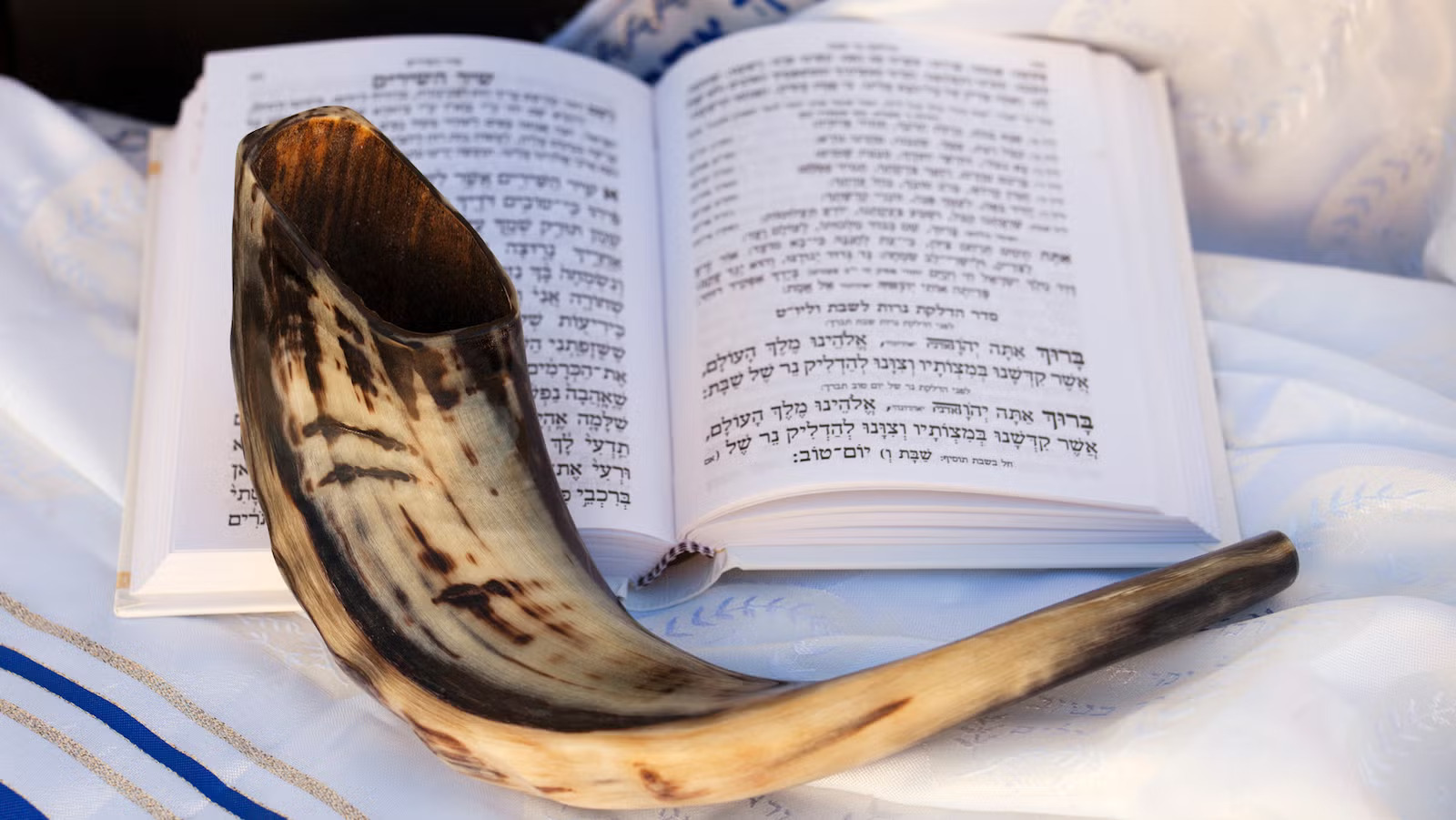
The most central observance of the Jewish New Year is the sounding of the Ram’s horn- the Shofar. So important in fact that this holiday is not even called Rosh Hashana! The rabbi’s invented that. It never calls it that in the Torah. You know what this day is called in the Torah? “Yom Teruah”- “The Day of the Shofar Blast”.
Strangely, when Rosh Hashana falls on Shabbos, as it does this year, we don’t blow the Shofar!!
I’m not going to get into the explanation of why because there are at least 3 explanations and the only one of them that makes sense to me is actually rejected in practice. I’ll fill you in later if you are interested.
I want to offer my own explanation. Year after year we focus on the shofrot and zichronot, on renewal, on improvement, the sound and fury of Rosh Hashana. Every couple years, we should focus on the Malchuyot- that God is King and everything is good enough as it is. Most years the call is for action, this year the call is for faith. It makes sense that this happens on the years when Rosh Hashana falls on Shabbos. The word Shabbos comes from the same root- “shuv- stop and rest.”
9. So this year, believe in yourself but even more so, believe that Hashem loves and believes in you.
The first words we say as Jews when we wake up is the Modeh Ani- a prayer thanking God for restoring our souls each morning. The short prayer ends with the words-
“Rabbah Emunahsecha” which means “great is Your faith”. I’ve always understood that to mean, “great is your faith in me”. You must really love me and believe in me to give me the gift of life for another day. Hashem loves and believes in each one of us. This Rosh Hashana, let us realize that to maintain and just be us is enough for once.
Maybe I am on my way down the mountain. But I’ll smile and take my time as I go. It’s not that I commit myself to start climbing today. I’ve been climbing for 45 years and I expect I’ll be climbing in one way or another as long as I’m on this earth. I’ll go with the wisdom that I’m enough as I am, and that I’ve been working hard for many years which is the meaning of life, and I will continue to do so. That is enough, to have a direction and get up every day and keep walking slowly. And if that walk is so slow that it’s a crawl, it’s fine. This Rosh Hashana, it’s fine… as long as I crawl with God.
Good Shabbos, Good Yuntif, Shana Tova!!